


Business expansion doesn’t look the way it did even five years ago. Companies are hiring across cities, countries, and time zones at a pace that would have seemed unmanageable a decade ago. That access to global talent has opened doors but it’s also exposed how unprepared most payroll systems are for the way businesses actually grow now.
Here’s what a lot of organizations don’t see coming: payroll gets complicated fast once you cross a single region. Paying a growing team is one challenge. Keeping up with tax codes, labor laws, statutory deductions, and compliance rules across multiple jurisdictions is a completely different problem and it’s usually the one that catches leadership off guard.
This is exactly where a smarter payroll strategy starts to earn its place at the growth table.
Where Traditional Payroll Breaks Down
For most scaling companies, manual payroll eventually turns into a bott leneck. HR and finance teams are already juggling hiring, retention, and reporting and once payroll complexity gets added on top, something usually slips.
The problem is, payroll mistakes don’t stay small. A late salary run, a wrong tax filing, a missed compliance deadline any one of these can turn into a financial hit or a trust problem with employees almost overnight.
That’s the real reason so many organizations have stopped trying to manage it all in-house.
Payroll and EOR: Not Just Admin, Actually Strategic
Payroll outsourcing takes the processing, compliance tracking, and statutory filing off a company’s plate and hands it to people who do this full-time. The upside isn’t just fewer errors it’s that internal teams get their bandwidth back for things that actually move the business forward.
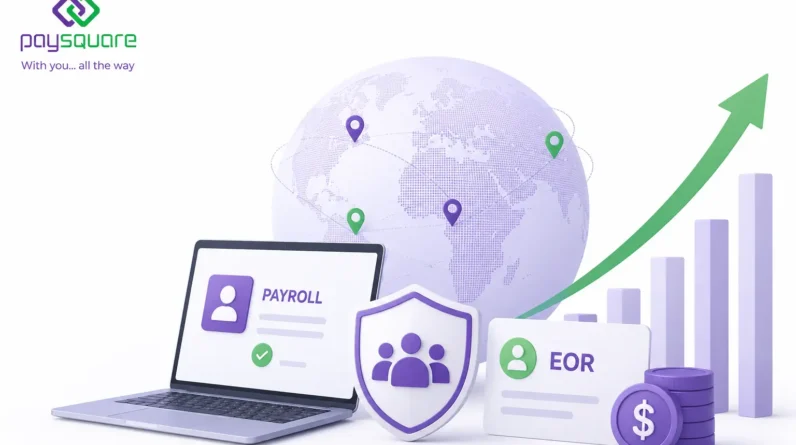
For companies hiring across borders, Employer of Record services solve a different problem entirely. An EOR lets a business put someone on payroll in another country without going through the process of setting up a legal entity there. The EOR takes on the local employment relationship payroll, statutory benefits, compliance while the company keeps full control over what that person actually works on day to day.
Put simply: it removes one of the most painful barriers to hiring globally.
Picking the Right Model
There isn’t one right answer here, and that’s worth saying clearly.
Companies operating in a single, established market usually get the most value from straightforward payroll outsourcing – it tightens up efficiency and lowers compliance risk without overcomplicating things. Companies testing a new country, on the other hand, tend to lean on EOR services because it offers speed without forcing a big upfront commitment.
A lot of fast-growing businesses end up running both at once – outsourcing payroll where they’re already established, and using EOR to test new markets before going all in. It’s a hybrid approach, but it works because it keeps growth flexible without losing control.
Growth isn’t only about entering new markets faster. It’s about building the operational backbone that lets you do that without everything behind the scenes falling apart.
That’s really the shift happening here payroll is no longer just an admin function teams tolerate. Done right, it becomes part of how a company actually grows.
As more businesses scale across regions, the partner behind their payroll matters more than ever. Paysquare works with organizations to simplify payroll, stay compliant, and support smooth workforce expansion through tailored payroll and EOR solutions.